arpthark wrote: Thu Oct 30, 2025 6:53 am
I had one here briefly, on loan from a friend who let me check it out. Unusable scale, cool instrument. Weird tapers in the bugle, interestingly shaped bell. Out of all the early 20th century makers, Buescher is (IMO) the most unique in their designs. I had a really nice one of their recording bell BBbs for a while before I sold it to Don Butterfield’s son in law.
Do you happen have a picture of it? They really did have some unique designs. They weren’t afraid to go their own way!
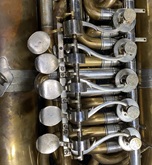
Here it is next to a York monster Eb I had for a bit. You’ll notice it’s much taller, and the bell stack has a pretty conservative taper before it gets to the bell flare. The top bow has a very noticeable sudden expansion right above the valve section.
edit for larger pic
Last edited by arpthark on Thu Oct 30, 2025 1:19 pm, edited 1 time in total.
These users thanked the author arpthark for the post:
bloke wrote: Thu Oct 30, 2025 7:17 am
Ferree's Tools seems (??) to be slowly fading in the west yet sustaining itself with products that it designed and began manufacturing decades ago.
It seems to me that the perfect type of tool for them to have invented would be a thing that fits between vice jaws with a convex roller against another concave roller, and perhaps with interchangeable wheels to accommodate a couple of different sizes of rib material - along with a clamp and a hand grip to grab the end of a piece of tuba or sousaphone rib material. One would grease and insert the material in the device and pull it through, whereby the device would iron out all the dents. One would clean all the solder off first, and - to make it even easier - the dented rib material could be annealed prior to greasing it up and inserting it in the device... It would need some adjustable side rails to keep the material centered on the rollers, yes? Also, the rollers would need to be adjustable as far as how closely the concave articulates against the convex one. The really screwed up places would need to go through a few times - with additional tension each time - until they were finally ironed out completely.
I bet a bunch of y'all are thinking that this is a pretty good idea, and the rest of y'all are thinking that it's just another dumb idea that bloke had.
I tried something with the same basic idea. One of those two handled (concave curve) rollers clamped to a board which clamped to my drill press table. Chucked a ball (sphere) ended punch in the drill press chuck. Lower the chuck (and therefore ball) down towards the roller. Run the guard rib through. Slightly lower chuck/ball. Repeat.
It works reasonably decently but could be improved upon.
These users thanked the author York-aholic for the post:
MiBrassFS wrote: Thu Oct 30, 2025 1:07 pm
Thanks for that, @arpthark. So interesting! I have never seen one like it. Monsters were… “monstrous” in more than one way!
I bet @bloke will notice the extra big “hole” from being “cut” to Eb…
I thought up a tool to straighten out guard wire over the last two days (whilst doing quite a bit of guard wire and guard wire-related repair work...
I ran the details of it through my head quite a few times, and I can't (at least, not yet) manage to find any flaws or fallacies in the design (though - admittedly - a concept).
The tool would need to be altered (with an addition set of guides, and perhaps a bit more robust) to actually FABRICATE guard wire...but whatever on that.
I don't know if it's true, but I've heard rumors that King guard wire may soon no longer be available. (I wouldn't be surprised to find that - suddenly - a whole bunch of other stuff is no longer available, but - not a rumor - that's just me wondering.)
I'm a big fan of monster Eb conversions, and have found that all they need to fix intonation is a larger valve section (and adjustments to make 'em 'fit': larger leadpipe and flare right after the valves). Pretty easy, and seems to fix whatever intonation flaws these horns had. What I consider an excellent modern version of this is the Wessex Tubby (no, I'm not selling anything; just like 'em a lot).
Tubby b.jpg (28.1 KiB) Viewed 2340 times
York-aholic wrote: Tue Oct 28, 2025 9:35 pm
Interesting to note (at least on the 3 York Monster Eb's I've owned) that things get quite squirrely on them at about 1st & 3rd BBb. Isn't that the equivalent note as the dreaded low CC on an F tuba?
On 5 valve conversions, fingering 125 seems to work pretty well for the low Bb. My two cents.
These users thanked the author UncleBeer for the post:
The most in tune (yet with flaws) large E flats seem to be those that the English built (and have been copied by others) that were originally set up as compensating instruments.
The 8th partial with these instruments is still saggy - just as with the American monsters, but - to me - they're better in tune than any of the American monsters. Oddly, when one of the Chinese instrument importers shoehorned a non-compensating front action valve set on a copy of this bugle, it didn't seem to play as well in tune.
I've been playing an E flat something or other since about 1979 in jazz combos, and several years ago finally lucked into a recording bell version of the English 3 + 1 compensating E flat - the same as is now listed on eBay. These are quite rare, (again) I really lucked into this instrument, and I wish I'd had it since 1979. Otherwise, I probably should have been playing a regular 19 inch upright bell 3+1 compensating E flat made in England since 1979. Back in the mid-70s - when I had very little experience with models other than those that I owned (and wasn't the flexible enough player to adjust my own playing to an instrument and simply judged how instruments responded to me playing them AS IF they were the instruments that I owned), I tried out a compensating E-flat at one of the tuba shindigs, it felt very strange to me, I rejected it, but I later heard James Gourlay play a beautiful solo on one in the early '80s and realized that they were viable, but still didn't seek one out for myself at that time.