
Imagine a tuba that was built so accurately that the #1 and #3 slides were braced together and moved together, and only offered the additional resistance of four slide tubes moving at once rather than two.
With one dual device held by a thumb in an index finger, a tiuba player could tune any first valve pitches, any first and second valve pitches, any second and third valve pitches, any first and third valve pitches, and any first second and third valve pitches.
Was such a device, tuning any pitches that involve the fourth or fifth valves would also be a cinch... and imagine such a setup on a tuba that already plays fairly well in tune...
I suppose a plumbing system similar to the pt6p setup would be a good one to examine and adapt to such a system, as the third and first slides are arranged so that both can already be fairly easily reached by the left hand.
the advantages to this theoretical precision build:
Forum rules
This section is for posts that are directly related to performance, performers, or equipment. Social issues are allowed, as long as they are directly related to those categories. If you see a post that you cannot respond to with respect and courtesy, we ask that you do not respond at all.
This section is for posts that are directly related to performance, performers, or equipment. Social issues are allowed, as long as they are directly related to those categories. If you see a post that you cannot respond to with respect and courtesy, we ask that you do not respond at all.
-
bloke
- Mid South Music
- Posts: 24361
- Joined: Thu Aug 13, 2020 8:55 am
- Location: western Tennessee - near Memphis
- Has thanked: 5223 times
- Been thanked: 5887 times
-
russiantuba
- Posts: 752
- Joined: Thu Aug 13, 2020 8:04 am
- Location: Circleville, Ohio
- Has thanked: 61 times
- Been thanked: 324 times
- Contact:
Re: the advantages to this theoretical precision build:
Why not a main tuning slide kicker like many euphoniums have.
Newer Miraphone Petrushkas have this too
Newer Miraphone Petrushkas have this too
Dr. James M. Green
Lecturer in Music--Ohio Northern University
Adjunct Professor of Music--Ohio Christian University
Gronitz PF 125
Miraphone 1291CC
Miraphone Performing Artist
www.russiantuba.com
Lecturer in Music--Ohio Northern University
Adjunct Professor of Music--Ohio Christian University
Gronitz PF 125
Miraphone 1291CC
Miraphone Performing Artist
www.russiantuba.com
-
UncleBeer
- Posts: 675
- Joined: Thu Aug 13, 2020 8:37 am
- Has thanked: 111 times
- Been thanked: 432 times
Re: the advantages to this theoretical precision build:
I still like the upward-facing main tuning slide of the Marzans. Surprised no other manufacturers have tried this.
- These users thanked the author UncleBeer for the post (total 2):
- York-aholic (Mon Jan 05, 2026 2:27 am) • the elephant (Mon Jan 05, 2026 2:55 pm)
-
York-aholic
- Posts: 1827
- Joined: Thu Aug 13, 2020 10:39 pm
- Location: SoCal
- Has thanked: 2371 times
- Been thanked: 686 times
Re: the advantages to this theoretical precision build:
I was just going to say this...UncleBeer wrote: Mon Jan 05, 2026 2:09 am I still like the upward-facing main tuning slide of the Marzans. Surprised no other manufacturers have tried this.
Great minds...
- These users thanked the author York-aholic for the post:
- UncleBeer (Wed Jan 07, 2026 1:23 am)
Some old Yorks, Martins, and perhaps a King rotary valved CC
Re: the advantages to this theoretical precision build:
My Amati B&F Kaiser is currently at Adams to have some work done. The handle on the 1st slide is being moved to the 3rd slide (which is behind the 1st). Both slides can then be manipulated from the same hand position.
I do generally need to push the 1st slide in (for the C in the staff) and the 3rd out (in the pedal register), so how do you imagine that with the 'linked' 1st and 3rd?
I do generally need to push the 1st slide in (for the C in the staff) and the 3rd out (in the pedal register), so how do you imagine that with the 'linked' 1st and 3rd?
-
bloke
- Mid South Music
- Posts: 24361
- Joined: Thu Aug 13, 2020 8:55 am
- Location: western Tennessee - near Memphis
- Has thanked: 5223 times
- Been thanked: 5887 times
Re: the advantages to this theoretical precision build:
I really don't like the idea of constantly moving the baseline... and I do mean baseline and not "bass line".russiantuba wrote: Sun Jan 04, 2026 6:02 pm Why not a main tuning slide kicker like many euphoniums have.
Newer Miraphone Petrushkas have this too
A tune any note device obligates the player to move it back every time it's moved "or else". A few of them self-center, but I've never seen a self-centering tune any note device that stays adjusted very long, and nor have I ever seen one that self-centers back to a precise spot reliably.
If slides 1 and 3 were precision aligned with each other, it wouldn't require much pull at all to tune the 1-3 pitch D or C (or even C sharp or B natural) depending on whether it's a B flat instrument or a C instrument. This solves the problem of the bad choices of 1-3 (epic #1 slide pull) vs 4 (flat(, and 2-4 (sharp) vs 5-2-3 (flat) on the third partial, and also offers a ergonomic way to deal with wonky 2-3 combination intonation issues. (It's the old trombone joke about 5th position - which is equivalent of 2-3, whereas no one really knows where fifth position is.)
Yeah I understand the tune any note concept, but again it requires immediately undoing what was done every single time, where is a system where one and three move together would offer some relief in regards to that demand to immediately correct what was just done, as quite a few pitches are played on the open instrument and with only the second valve depressed...
... and again, I personally prefer leaving an instrument's baseline tuning alone.
It's easy to criticize me for this preference, but - well - it's a preference of mine, just as is preferring - with a four valve compensating system - to not put all four valves on the front, as - if there's going to be an "anchoring" or "change" valve - ie. the fourth valve - I prefer to operate it with the other hand (as is traditional), rather than trying to anchor with the pinky finger of the same hand that's operating valves 1, 2, and 3.
If I ever decide to install a tune any note device on a main tuning slide of one of my instruments - and I manage to install a re-centering device that returns to -precisely- the same spot every single time (and without making the main slide fit so loosely that it leaks air - as with so many of those euphonium triggers...yet they don't even feature centering devices) I'd let everyone know... I'd be pretty proud of such an accomplishment.
Last edited by bloke on Mon Jan 05, 2026 3:10 pm, edited 1 time in total.
- These users thanked the author bloke for the post:
- the elephant (Mon Jan 05, 2026 2:56 pm)
-
gocsick
- Posts: 1016
- Joined: Mon Sep 11, 2023 11:12 am
- Has thanked: 421 times
- Been thanked: 493 times
Re: the advantages to this theoretical precision build:
You just need to build a robotic main tubing slide actuator.. like this one for trombone
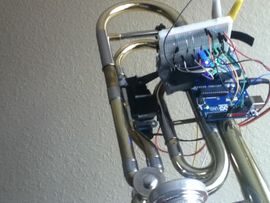
https://www.instructables.com/Arduino-A ... one-Tuner/
https://www.instructables.com/Arduino-A ... one-Tuner/
As amateur as they come...I know just enough to be dangerous.
Meinl-Weston 20
Holton Medium Eb 3+1
Holton Collegiate Sousas in Eb and BBb
Conn 20J
and whole bunch of other "Stuff"
Meinl-Weston 20
Holton Medium Eb 3+1
Holton Collegiate Sousas in Eb and BBb
Conn 20J
and whole bunch of other "Stuff"
Re: the advantages to this theoretical precision build:
Nah...just add more valves, Dr. Young had it right
https://www.researchgate.net/profile/Frederick-Young-2
https://www.researchgate.net/profile/Frederick-Young-2
- dr young gif.gif (115.02 KiB) Viewed 2674 times
B&S 3098 PT-6
B&S "Sonora" CC
B&S 4196 PT-4P
Holton 345 CC
B&S "Sonora" CC
B&S 4196 PT-4P
Holton 345 CC
-
Schlitzz
- Posts: 792
- Joined: Mon Sep 21, 2020 11:36 am
- Location: Kitsapalaccia, WA
- Has thanked: 168 times
- Been thanked: 161 times
Re: the advantages to this theoretical precision build:
Yeah, but there’s the violas, and trumpets.russiantuba wrote: Sun Jan 04, 2026 6:02 pm Why not a main tuning slide kicker like many euphoniums have.
Newer Miraphone Petrushkas have this too
They have no clue to listen, or to properly use that third valve slide. Never mind .
Yamaha 641
Hirsbrunner Euph
I hate broccoli.
Hirsbrunner Euph
I hate broccoli.
-
bloke
- Mid South Music
- Posts: 24361
- Joined: Thu Aug 13, 2020 8:55 am
- Location: western Tennessee - near Memphis
- Has thanked: 5223 times
- Been thanked: 5887 times
Re: the advantages to this theoretical precision build:
Well there's a second thing I could be taking to a friend to get rid of 60 cycle hum....gocsick wrote: Mon Jan 05, 2026 10:13 am You just need to build a robotic main tubing slide actuator.. like this one for trombone
https://www.instructables.com/Arduino-A ... one-Tuner/
-
bloke
- Mid South Music
- Posts: 24361
- Joined: Thu Aug 13, 2020 8:55 am
- Location: western Tennessee - near Memphis
- Has thanked: 5223 times
- Been thanked: 5887 times
Re: the advantages to this theoretical precision build:
My favorite setup is 4 + 2dp wrote: Mon Jan 05, 2026 10:21 am Nah...just add more valves, Dr. Young had it right
https://www.researchgate.net/profile/Frederick-Young-2
dr young gif.gif
The only instrument I have that set up like that (no not perfectly in tune using those six valves, but) is so flexible that I don't need to pull slides.
I just don't know how a seventh valve would define spot on intonation...
... and it's not that I myself blow perfectly in tune, but - when the instrument is the perfect length, that greatly increases my chances.
The most prolific contractor around here is a very fine trombonist. I work with him a lot. The easier I make it for him consistently, the more likely he is to think of me when he needs somebody to play the tuba. Not boastfully but candidly, I like it when I hear one of the trombone players say quietly to one of the others, "Oh good! bloke's here." For freelancing, that's sort of like job security.
-
the elephant

- Posts: 4780
- Joined: Thu Aug 13, 2020 8:39 am
- Location: 32°50'57.0"N 90°24'34.9"W
- Has thanked: 2997 times
- Been thanked: 2367 times
Re: the advantages to this theoretical precision build:
Here comes my completely unsolicited input, so snub up your man panties if you fall into that category…
I either love or detest the idea of using the main slide adjustment for everything. Here is what I mean…
My Alexander 163 came to me with an MTS tuning stick. I tried like the dickens to get used to it. After a while, I discovered that just about every pitch on the horn could be fixed using the 1st slide (which is how I had been trained since my "young whelp" days), so I quickly removed that dang, hated stick from the horn.
EVERYTHING ABOUT THE HORN GOT BETTER after I made this discovery.
Like Joe, I really hate having to move "home base", as that is my fixed reference point for how much to push or pull. I want the slide "there" as I press the valve, not after, so I need to know where it will go. If I am on a note that needs a long pull, move to one that is a medium push, then play an in-tune note, extra CPU processing time is needed for me to "correct the correction". Big, dumb guys such as myself can easily get lost in all of this adjustment. I personally need a pitch "home base" from which to work.
FOR ME, then, the best system of all is the Marzan-style top correction slide WITH A SEPARATE MAIN SLIDE FOR OVERALL TUNING. I want TWO main slides. My Kalison Daryl Smith prototype (bought from Paul K in Philly in 1993) had two MT slides, and I rigged the top one to be adjustable with my left hand. It was wonderful, unlike the terrible time I had with the Alex until I wised up and stopped trying to use the ONLY main slide for tuning.
Regarding the 4+2 system: I have only experienced 6-valved tubas that were so out of tune that you NEEDED the additional choices the 6th valve gave the player. The low ranges were so bad that the 5th and 6th were sort of like acoustic appendices, with little to no use.
Until Joe gave me a true eureka moment by explaining to me how he used the 6th valve on his Symphonie. You see, the few (doggy) 6-valved tubas I had played used the older system whereby the index finger was the long half step, and the middle finger was a long whole step, and this made NO SENSE to me. Then, when he explained that his was the opposite, and that they functioned as a 1 and 2 for a CC tuba (fingering-wise) when the 4th was down, it all just clicked: If you have a well-in-tune tuba with 6 valves (set up like Joe's), THIS IS BRILLIANT!
My Kurath, the ancestor to the later OG Willson 3200-FA-5, is a fine tuba, if perhaps a bit too big for its intended use (IMHO). The Willson has excellent intonation, with a few known bugs, which are unfortunately common in the F tuba world, and the Kurath is very similar to these horns in this regard.
I did a lot of work to my prototype Kurath, including correcting some truly bizarre stuff in the taper of the valve section that had to be Friday Afternoon Syndrome. Get it built. Get it packed. Get it shipped. Get paid. I won't go into the horrors I discovered, but it plays much better now. The intonation is better overall from any Willson 3200 and most of these earlier, very nicely made Kuraths. Adding a 6th valve totally changed how the horn plays below low C, and I love it.
I sold my excellent Adams F because I could not figure out where to shoehorn in a 6th valve, and did not want to go back to the restrictive nature of a 5-valved F. It was THAT much of an improvement (for me).
The ONLY thing I would like to do would be to add a proper 7th valve because that would make this a true double tuba, and the low range would become more or less perfect for me. The ONLY note in that range of this tuba is low Ab, and having a 7th would fix it nicely.
Alas, there is no room for another valve…
Unless…
Naaaaah…
I would like to try out a tuba modified as Joe suggests. However, I do not think I would gain much from it that I cannot already achieve with the easily accessible 3rd slides on both tubas, despite the small hand movements required for these adjustments. Still, it would be great to have the 23 series under easier control without having to move my hard.
For me, though, the double MTS setup I had on my Kalison was wonderful. I tuned the horn with the lower slide, and then adjusted it with the upper. I could fix the open pitches too, that way, while never losing my baseline pitch adjustment. If the group blew sharp on some big, Mahler-esque passage, I could keep up by pushing in the adjuster slide until I could get a hand down to the main slide.
The Tune-Any-Note feature on Kanstul G bugles worked like this. There was a front "tuning" slide on the bugle, then a rear "adjustment" slide with a thumb saddle or ring. This was an outgrowth of the infamous "cheater" slides used by the Bue Devils on their King bugles around 1983, which had a tubing layout that would allow for a saddle on the main slide that could be adjusted by the left thumb (replacing the adjuster on the 1st slide). These were very illegal, and they had to remove them.
Zig saw the need for such a contraption, and when he started building his own-brand bugles, he worked that into the design. This was modified and then included on all of his later Bb/F marching brass and eventually all of his tubas (I think). It is a great idea, but it ends up needing too much cylindrical tubing to use on a really large tuba, IMHO, without introducing weirdness. It worked well on his F tubas, though.
[Perhaps the two-slide system was only on the prototypes I played? I never played a production Kanstul instrument, so I honestly do not know what the production version of Tune-Any-Note was like. I suspect it moved to a single slide, and I would have hated that. But it would have been simpler, faster, and cheaper for them to make.]
And those are my random, detached thoughts about everything I read above this reply to Joe's thread.
And they lived happily ever after.
The End

I either love or detest the idea of using the main slide adjustment for everything. Here is what I mean…
My Alexander 163 came to me with an MTS tuning stick. I tried like the dickens to get used to it. After a while, I discovered that just about every pitch on the horn could be fixed using the 1st slide (which is how I had been trained since my "young whelp" days), so I quickly removed that dang, hated stick from the horn.
EVERYTHING ABOUT THE HORN GOT BETTER after I made this discovery.
Like Joe, I really hate having to move "home base", as that is my fixed reference point for how much to push or pull. I want the slide "there" as I press the valve, not after, so I need to know where it will go. If I am on a note that needs a long pull, move to one that is a medium push, then play an in-tune note, extra CPU processing time is needed for me to "correct the correction". Big, dumb guys such as myself can easily get lost in all of this adjustment. I personally need a pitch "home base" from which to work.
FOR ME, then, the best system of all is the Marzan-style top correction slide WITH A SEPARATE MAIN SLIDE FOR OVERALL TUNING. I want TWO main slides. My Kalison Daryl Smith prototype (bought from Paul K in Philly in 1993) had two MT slides, and I rigged the top one to be adjustable with my left hand. It was wonderful, unlike the terrible time I had with the Alex until I wised up and stopped trying to use the ONLY main slide for tuning.
Regarding the 4+2 system: I have only experienced 6-valved tubas that were so out of tune that you NEEDED the additional choices the 6th valve gave the player. The low ranges were so bad that the 5th and 6th were sort of like acoustic appendices, with little to no use.
Until Joe gave me a true eureka moment by explaining to me how he used the 6th valve on his Symphonie. You see, the few (doggy) 6-valved tubas I had played used the older system whereby the index finger was the long half step, and the middle finger was a long whole step, and this made NO SENSE to me. Then, when he explained that his was the opposite, and that they functioned as a 1 and 2 for a CC tuba (fingering-wise) when the 4th was down, it all just clicked: If you have a well-in-tune tuba with 6 valves (set up like Joe's), THIS IS BRILLIANT!
My Kurath, the ancestor to the later OG Willson 3200-FA-5, is a fine tuba, if perhaps a bit too big for its intended use (IMHO). The Willson has excellent intonation, with a few known bugs, which are unfortunately common in the F tuba world, and the Kurath is very similar to these horns in this regard.
I did a lot of work to my prototype Kurath, including correcting some truly bizarre stuff in the taper of the valve section that had to be Friday Afternoon Syndrome. Get it built. Get it packed. Get it shipped. Get paid. I won't go into the horrors I discovered, but it plays much better now. The intonation is better overall from any Willson 3200 and most of these earlier, very nicely made Kuraths. Adding a 6th valve totally changed how the horn plays below low C, and I love it.
I sold my excellent Adams F because I could not figure out where to shoehorn in a 6th valve, and did not want to go back to the restrictive nature of a 5-valved F. It was THAT much of an improvement (for me).
The ONLY thing I would like to do would be to add a proper 7th valve because that would make this a true double tuba, and the low range would become more or less perfect for me. The ONLY note in that range of this tuba is low Ab, and having a 7th would fix it nicely.
Alas, there is no room for another valve…
Unless…
Naaaaah…
I would like to try out a tuba modified as Joe suggests. However, I do not think I would gain much from it that I cannot already achieve with the easily accessible 3rd slides on both tubas, despite the small hand movements required for these adjustments. Still, it would be great to have the 23 series under easier control without having to move my hard.
For me, though, the double MTS setup I had on my Kalison was wonderful. I tuned the horn with the lower slide, and then adjusted it with the upper. I could fix the open pitches too, that way, while never losing my baseline pitch adjustment. If the group blew sharp on some big, Mahler-esque passage, I could keep up by pushing in the adjuster slide until I could get a hand down to the main slide.
The Tune-Any-Note feature on Kanstul G bugles worked like this. There was a front "tuning" slide on the bugle, then a rear "adjustment" slide with a thumb saddle or ring. This was an outgrowth of the infamous "cheater" slides used by the Bue Devils on their King bugles around 1983, which had a tubing layout that would allow for a saddle on the main slide that could be adjusted by the left thumb (replacing the adjuster on the 1st slide). These were very illegal, and they had to remove them.
Zig saw the need for such a contraption, and when he started building his own-brand bugles, he worked that into the design. This was modified and then included on all of his later Bb/F marching brass and eventually all of his tubas (I think). It is a great idea, but it ends up needing too much cylindrical tubing to use on a really large tuba, IMHO, without introducing weirdness. It worked well on his F tubas, though.
[Perhaps the two-slide system was only on the prototypes I played? I never played a production Kanstul instrument, so I honestly do not know what the production version of Tune-Any-Note was like. I suspect it moved to a single slide, and I would have hated that. But it would have been simpler, faster, and cheaper for them to make.]
And those are my random, detached thoughts about everything I read above this reply to Joe's thread.
And they lived happily ever after.
The End
Last edited by the elephant on Mon Jan 05, 2026 3:59 pm, edited 1 time in total.
- These users thanked the author the elephant for the post:
- gocsick (Mon Jan 05, 2026 5:47 pm)

-
catgrowlB
- Posts: 318
- Joined: Tue Jun 13, 2023 8:46 pm
- Has thanked: 296 times
- Been thanked: 124 times
Re: the advantages to this theoretical precision build:
Complete with stools and white gloves...dp wrote: Mon Jan 05, 2026 10:21 am Nah...just add more valves, Dr. Young had it right
https://www.researchgate.net/profile/Frederick-Young-2
dr young gif.gif


They have. Cazzani did it decades before Marzan. How do I know this? Because I have a Cazzani BBb that I turned into a Franken BBb years ago -- Cazzani body/valveset, B&S Sonora copy mouthpipe, and Holton Monster Eb bell, along with a few other small changes. It plays much better as a frankentuba than it did as an old Cazzani BBb from the 1920s-1930s. Certainly not perfect though. The main tuning slide is upwards facing, on the back of the horn.UncleBeer wrote: Mon Jan 05, 2026 2:09 am I still like the upward-facing main tuning slide of the Marzans. Surprised no other manufacturers have tried this.
Also, Yamaha has two main tuning slides on the new YCB-623/YBB-623 tubas. One of the main tuning slides is upward facing

- These users thanked the author catgrowlB for the post (total 2):
- the elephant (Mon Jan 05, 2026 4:00 pm) • hrender (Mon Jan 05, 2026 5:55 pm)
-
the elephant
- Posts: 4780
- Joined: Thu Aug 13, 2020 8:39 am
- Location: 32°50'57.0"N 90°24'34.9"W
- Has thanked: 2997 times
- Been thanked: 2367 times
Re: the advantages to this theoretical precision build:
Another "coolness point" for the 623. I want to try one of them one day,
- These users thanked the author the elephant for the post (total 2):
- York-aholic (Mon Jan 05, 2026 5:53 pm) • catgrowlB (Wed Jan 07, 2026 12:12 am)
-
York-aholic
- Posts: 1827
- Joined: Thu Aug 13, 2020 10:39 pm
- Location: SoCal
- Has thanked: 2371 times
- Been thanked: 686 times
Re: the advantages to this theoretical precision build:
I guess if it’s a main slide tuner, rather than calling it a “tune any note” it should be a
“Tune every note”
Which I agree could get annoying quite quickly.
“Tune every note”
Which I agree could get annoying quite quickly.
Some old Yorks, Martins, and perhaps a King rotary valved CC
-
bloke
- Mid South Music
- Posts: 24361
- Joined: Thu Aug 13, 2020 8:55 am
- Location: western Tennessee - near Memphis
- Has thanked: 5223 times
- Been thanked: 5887 times
Re: the advantages to this theoretical precision build:
Truth be told. I seriously doubt that a first and third pair of slides unified would would be particularly easy to slide (even if absolutely perfectly aligned, and each of the four pairs of tubes fitting as if a piston to a casing) unless they leaked more than I would wish for them to... It's a surface area and friction issue.
It's the same issue as with the big Conn short action valves. Unless the tolerances are compromised (shhhh... as they actually have to be for those very large diameter valves to move quickly), they're going to move too slowly and the (who cares, actually) supposed advantage of the short stroke will be completely negated (via reduced piston speed).
...so what I was proposing at the top is actually only theoretical, but I like the idea - were it possible for it to be real.
...and were it actually to work, it would be sort of like a short action valve in that some of the sliding distance on the fly involved would be half as much, and it would offer easy access to the third slide (whereas 2-3 is so random as far as how in tune with each other the various overtones with that valve combination tend to be).
summary:
If I really thought it would work, I might try it even though it would be very difficult to dial it in, but I think there would be too much friction with all that surface area moving against all that other surface area simultaneously.
bloke:
Tubas that cannot be played in tune without moving the main tuning slide constantly or using a bunch of goofy fingerings are non-starters for me. I've lived through those tubas in past decades, and choose to not live through any more of them. It's just easier to spend enough money to buy one that's more intonation-friendly than that.
No one reading this but me knows who Dr Willie Herenton was, but (very briefly) he was forced to resign as school board superintendent in disgrace, ran for mayor, the election was stolen for him in the wee hours, and he was re-elected perhaps a couple more times after that.
All that aside, I loved one quote of his:
It's the same issue as with the big Conn short action valves. Unless the tolerances are compromised (shhhh... as they actually have to be for those very large diameter valves to move quickly), they're going to move too slowly and the (who cares, actually) supposed advantage of the short stroke will be completely negated (via reduced piston speed).
...so what I was proposing at the top is actually only theoretical, but I like the idea - were it possible for it to be real.
...and were it actually to work, it would be sort of like a short action valve in that some of the sliding distance on the fly involved would be half as much, and it would offer easy access to the third slide (whereas 2-3 is so random as far as how in tune with each other the various overtones with that valve combination tend to be).
summary:
If I really thought it would work, I might try it even though it would be very difficult to dial it in, but I think there would be too much friction with all that surface area moving against all that other surface area simultaneously.
bloke:
Tubas that cannot be played in tune without moving the main tuning slide constantly or using a bunch of goofy fingerings are non-starters for me. I've lived through those tubas in past decades, and choose to not live through any more of them. It's just easier to spend enough money to buy one that's more intonation-friendly than that.
No one reading this but me knows who Dr Willie Herenton was, but (very briefly) he was forced to resign as school board superintendent in disgrace, ran for mayor, the election was stolen for him in the wee hours, and he was re-elected perhaps a couple more times after that.
All that aside, I loved one quote of his:
bloke "damn right (in regards to badly out of tune tubas)"I ain't got no time foe dis.
-
the elephant
- Posts: 4780
- Joined: Thu Aug 13, 2020 8:39 am
- Location: 32°50'57.0"N 90°24'34.9"W
- Has thanked: 2997 times
- Been thanked: 2367 times
Re: the advantages to this theoretical precision build:
The 3rd slide, as normally wrapped on a front piston tuba, could be rerouted to do this without having to do anything to the casing block knuckles.
*could*
I think on a smaller-than-.750"-bore horn, this could work.
I do not think it could be made to slide fast/freely enough for larger bores, so most rotary tubs would be out. (Even the moderately-sized 186 has a .769" bore).
This reminds me ot that funny, little Getzen "marching" trombone from the seventies and eighties with the slide folded in half. (What was it called?) Your slide positions were half the normal length, so it gave the player better balance and faster technique.
Or so they tried to get trombonists to believe…
*could*
I think on a smaller-than-.750"-bore horn, this could work.
I do not think it could be made to slide fast/freely enough for larger bores, so most rotary tubs would be out. (Even the moderately-sized 186 has a .769" bore).
This reminds me ot that funny, little Getzen "marching" trombone from the seventies and eighties with the slide folded in half. (What was it called?) Your slide positions were half the normal length, so it gave the player better balance and faster technique.
Or so they tried to get trombonists to believe…
-
bloke
- Mid South Music
- Posts: 24361
- Joined: Thu Aug 13, 2020 8:55 am
- Location: western Tennessee - near Memphis
- Has thanked: 5223 times
- Been thanked: 5887 times
Re: the advantages to this theoretical precision build:
Quattro??the elephant wrote: Mon Jan 05, 2026 7:27 pm The 3rd slide, as normally wrapped on a front piston tuba, could be rerouted to do this without having to do anything to the casing block knuckles.
*could*
I think on a smaller-than-.750"-bore horn, this could work.
I do not think it could be made to slide fast/freely enough for larger bores, so most rotary tubs would be out. (Even the moderately-sized 186 has a .769" bore).
This reminds me ot that funny, little Getzen "marching" trombone from the seventies and eighties with the slide folded in half. (What was it called?) Your slide positions were half the normal length, so it gave the player better balance and faster technique.
Or so they tried to get trombonists to believe…
- These users thanked the author bloke for the post:
- the elephant (Mon Jan 05, 2026 9:20 pm)
-
the elephant
- Posts: 4780
- Joined: Thu Aug 13, 2020 8:39 am
- Location: 32°50'57.0"N 90°24'34.9"W
- Has thanked: 2997 times
- Been thanked: 2367 times
Re: the advantages to this theoretical precision build:
YES!
It was a silly little thing, but an interesting idea.
If you could bend runners to get the tubes to the correct locations, I would build the removable double slide using only the OUTER tubes so that you could brace it up pretty stoutly to preserve the alignment, but that would leave you with four upward-pointing inner tubes on the valve section of the horn, requiring some care when cleaning/immersing the instrument. I feel like having the four outer tubes being the sliders might work better.
I have no idea why this is. Just an idea…
It was a silly little thing, but an interesting idea.
If you could bend runners to get the tubes to the correct locations, I would build the removable double slide using only the OUTER tubes so that you could brace it up pretty stoutly to preserve the alignment, but that would leave you with four upward-pointing inner tubes on the valve section of the horn, requiring some care when cleaning/immersing the instrument. I feel like having the four outer tubes being the sliders might work better.
I have no idea why this is. Just an idea…
- These users thanked the author the elephant for the post:
- bloke (Mon Jan 05, 2026 9:21 pm)
-
bloke
- Mid South Music
- Posts: 24361
- Joined: Thu Aug 13, 2020 8:55 am
- Location: western Tennessee - near Memphis
- Has thanked: 5223 times
- Been thanked: 5887 times
Re: the advantages to this theoretical precision build:
off the main topic but touching on your comments about cleaning:
Like I've said before, my strategy is to oil the piss out of my instruments every time I play them, and jet hot water (too hot to touch - hot water tank thermostat turned all the way up for this job) through them every few months.
I might remove the first (often the 5th) rotor to see how much crap is actually still in the instrument.
Honestly, there usually isn't much.
Taking all these freaking tubas and French horns (etc.) apart all the time and giving them needed acid baths to dissolve lime... I just don't want to do that same crap to my own instruments without getting paid...so I try to not ever have to.
Like I've said before, my strategy is to oil the piss out of my instruments every time I play them, and jet hot water (too hot to touch - hot water tank thermostat turned all the way up for this job) through them every few months.
I might remove the first (often the 5th) rotor to see how much crap is actually still in the instrument.
Honestly, there usually isn't much.
Taking all these freaking tubas and French horns (etc.) apart all the time and giving them needed acid baths to dissolve lime... I just don't want to do that same crap to my own instruments without getting paid...so I try to not ever have to.
- These users thanked the author bloke for the post:
- the elephant (Mon Jan 05, 2026 11:54 pm)