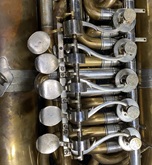
Must be the season of mid 70’s silver Miraphones that are in time capsule shape. Looks in very nice condition. I have to wonder though how likely their $9,500 price is going to find a buyer for a horn with 50 year old valves.
Mary Ann wrote: Sat Dec 06, 2025 12:31 pm
Is this person dreaming, or can this be sold for that amount of money? Who knows what the intonation characteristics are.
I feel like this is the second time I’ve seen this one on the market for a similar amount of money, so at least one person bought it for that amount.
These users thanked the author arpthark for the post:
Mary Ann wrote: Sat Dec 06, 2025 12:31 pm
Is this person dreaming, or can this be sold for that amount of money? Who knows what the intonation characteristics are.
I feel like this is the second time I’ve seen this one on the market for a similar amount of money, so at least one person bought it for that amount.
Mary Ann wrote: Sat Dec 06, 2025 12:31 pm
Is this person dreaming, or can this be sold for that amount of money? Who knows what the intonation characteristics are.
I feel like this is the second time I’ve seen this one on the market for a similar amount of money, so at least one person bought it for that amount.
Possibly it did not sell first time around.
Different sellers.
These users thanked the author arpthark for the post:
The 1970's non-F-tuba-players' (or people who didn't like fooling with the F tubas available at at that time) F tubas...and then - in the late 70's and 1980's - B&S F instruments began showing up in the USA.
These days, there are some Miraphone-made almost-4/4 models of B-flats (some that they never made many of, and others which are more recently developed) which are "more resonant" (read: "potentially louder"), and innately play considerably more well in tune.
It usually takes me a solid hour to get sorted on it and play it how I want. It takes more air than a horn its size seems like it should. The intonation takes some work. Articulation is hard to smooth out (usually it smooths out with the intonation getting locked in).
But. After an hour, it's wonderful. Singing tone. Crazy flexibility. Poppy pedal register.
It's definitely a hobby horn. Not one I'd want to have to rely on to play gigs every day. But as a hobby horn, I love it. And as I've said before, after an hour on the 184, I can't miss on my Gnagey.
These users thanked the author tubanh84 for the post:
tubanh84 wrote: Tue Jan 06, 2026 3:40 pm
I love my 184, but it's a beast to play.
It usually takes me a solid hour to get sorted on it and play it how I want. It takes more air than a horn its size seems like it should. The intonation takes some work. Articulation is hard to smooth out (usually it smooths out with the intonation getting locked in).
But. After an hour, it's wonderful. Singing tone. Crazy flexibility. Poppy pedal register.
It's definitely a hobby horn. Not one I'd want to have to rely on to play gigs every day. But as a hobby horn, I love it. And as I've said before, after an hour on the 184, I can't miss on my Gnagey.
yeah...Here goes bloke with his B-flat jazz again...
There have been (not even referring to the smaller of the "Hagen" line, but some stuff that seemed to have appeared and disappeared) some (perhaps?) 85-sized B-flat models that Miraphone produced (which I've serviced and played) that are remarkably fine instruments (tuning characteristics, "lively" sonic characteristics", loudness potential, etc.). I noticed a couple of things that I would have changed, but only stuff like "put this cylindrical tubing HERE so that cylindrical tubing can be placed THERE, or "If you would just bend the mouthpipe in this manner (allowing for it via taking some length away from this unnecessarily-long main tuning slide) there would be room for a 5th rotor and slide."