
Micing a Tuba
Forum rules
This section is for posts that are directly related to performance, performers, or equipment. Social issues are allowed, as long as they are directly related to those categories. If you see a post that you cannot respond to with respect and courtesy, we ask that you do not respond at all.
This section is for posts that are directly related to performance, performers, or equipment. Social issues are allowed, as long as they are directly related to those categories. If you see a post that you cannot respond to with respect and courtesy, we ask that you do not respond at all.
-
1 Ton Tommy
- Posts: 155
- Joined: Thu Mar 20, 2025 11:01 am
- Has thanked: 33 times
- Been thanked: 49 times
Micing a Tuba
Our local sound guy didn't have much to suggest so I thought maybe someone on this forum might have suggestions regarding make and model og microphones. I've been using various house sound's SM58s, some of which are better than others. There's gotta be something better than that.
Community orchestra member
1918 Martin Eb 4V, still played after 50 years
Martin Mammoth 4V, BBb
Wilson 3400 5V EEb
Assorted trumpets/cornet
Antique, Pan American trombone
1918 Martin Eb 4V, still played after 50 years
Martin Mammoth 4V, BBb
Wilson 3400 5V EEb
Assorted trumpets/cornet
Antique, Pan American trombone
-
catgrowlB
- Posts: 318
- Joined: Tue Jun 13, 2023 8:46 pm
- Has thanked: 296 times
- Been thanked: 124 times
Re: Micing a Tuba
The Shure sm57 and sm58 mics are sorta go-to standard mics. I'd think the sm57 would work a little better for tuba than the sm58, as the sm58 is geared more for vocals. The sound guy (I'm guessing 'live' amplification?) needs to place the mic close enough to your tuba bell and use enough gain (mic volume) at the board. He needs to do his part 
-
Yahnay-san
- Posts: 49
- Joined: Sun Aug 30, 2020 10:52 am
- Has thanked: 24 times
- Been thanked: 10 times
Re: Micing a Tuba
Get a short piece of pipe insulation or pool noodle to stick the mic into, hold this assembly inside your bell with gaffer’s tape. Just gaff if you are not particular about your horn’s finish. While some fancy condenser mic might be better, a 57 is adequate.
-
Mary Ann

- Posts: 4168
- Joined: Thu Aug 13, 2020 9:24 am
- Has thanked: 803 times
- Been thanked: 915 times
Re: Micing a Tuba
How does that compare to a Rode NT4, which is what I have, but it's got to be 25 years old. I used it with a Zoom H4 back in the day and for recording violin, it did a pretty good job. But I was recording at a distance because a violin miked up close does not sound like a violin.catgrowlB wrote: Mon Aug 25, 2025 9:46 pm The Shure sm57 and sm58 mics are sorta go-to standard mics. I'd think the sm57 would work a little better for tuba than the sm58, as the sm58 is geared more for vocals. The sound guy (I'm guessing 'live' amplification?) needs to place the mic close enough to your tuba bell and use enough gain (mic volume) at the board. He needs to do his part

Re: Micing a Tuba
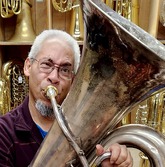
The Rode is a less directional than the SM57 so you would get more room echos with the Rode if you have the microphone some distance from the bell. If you put the microphone in the bell I don’t think you would hear much difference. I thought this video has some good information. In particular it shows the difference in sound between inside and outside the bell.Mary Ann wrote: Wed Aug 27, 2025 8:19 am How does that compare to a Rode NT4, which is what I have, but it's got to be 25 years old. I used it with a Zoom H4 back in the day and for recording violin, it did a pretty good job. But I was recording at a distance because a violin miked up close does not sound like a violin.
Re: Micing a Tuba
There's the idea from some sound folks that a bass drum kick mic is ideal for tuba. One local chirch I played did that.
There's also a video from the West Point band I've seen somewhere online about tuba recording, might be specific to audition tapes, but I remember the info being good
There's also a video from the West Point band I've seen somewhere online about tuba recording, might be specific to audition tapes, but I remember the info being good
-
catgrowlB
- Posts: 318
- Joined: Tue Jun 13, 2023 8:46 pm
- Has thanked: 296 times
- Been thanked: 124 times
Re: Micing a Tuba
Recording a tuba for video or digital handheld or other device to have 'permanently ' is different than recording 'live'. I've also heard about using bass drum mics for tuba. But I'd say for 'live', a dynamic mic like a Shure sm57 is always a good safe bet. Or maybe a good dynamic bass drum mic. A condenser mic (even a cheap Behrenger or Apex) will have better detail/clarity for uploaded/permanent recording, but not as durable or withstand loud sound environs as a dynamic mic.
Either way, the sound person needs to have a good ear and know what they are doing....
Either way, the sound person needs to have a good ear and know what they are doing....
I guess MikeS already answered that. But I've only heard the Rode NT1 (I think) compared to other mics on a piano and thought it kinda sounded a little 'flat' or muffled, but still OK. Each mic will 'color' the sound to an extent...Mary Ann wrote: Wed Aug 27, 2025 8:19 am
How does that compare to a Rode NT4, which is what I have, but it's got to be 25 years old. I used it with a Zoom H4 back in the day and for recording violin, it did a pretty good job. But I was recording at a distance because a violin miked up close does not sound like a violin.

Re: Micing a Tuba
I haven't done much tuba recording, but I have been through the double bass recording wringer with my son, and I think the challenges are similar. We were taught by his first bass teacher to record using two mics as separate tracks, and mix them afterward.
It feels a bit over the top to go through all this rigmarole for home recording, but oh how our ears have bled from simpler approaches!
- Shure SM57: Close to the bridge, orthogonal to the front of the bass. This primarily captures the direct sound from the bridge area, but sounds way better than a piezo bridge pickup.
- Rode NT1: Several feet away (ideally 6+), line of sight from the instrument, to capture the sound emanating from the whole instrument body. Ideally the room will be pretty dry, so that reverb is an optional effect rather than always along for the ride.
It feels a bit over the top to go through all this rigmarole for home recording, but oh how our ears have bled from simpler approaches!
Willson 2900 (B♭)
Yamaha YEB-632IIS (EE♭)
Willson 3400S-FA5 (EE♭)
Willson 3060-FA5 (CC)
Yamaha YEB-632IIS (EE♭)
Willson 3400S-FA5 (EE♭)
Willson 3060-FA5 (CC)
-
1 Ton Tommy
- Posts: 155
- Joined: Thu Mar 20, 2025 11:01 am
- Has thanked: 33 times
- Been thanked: 49 times
Re: Micing a Tuba
Love the video. I can't comment on what the SM58 sounds like because I'm not in the audience. I used to do interview recordings with an Omnidirectional and that picked up a lot of room tone. Sometimes too much. Many years ago an old timey band I played with for contra dances taped an SM58 in the bell, metal to metal but that was too hot and the room acoustics were better un-miced. After a few weeks they got an extra mic stand and put the SM58 in that but it picked up too much of the other instruments. I sat between the piano and the banjo. I think the SM57 would have worked better. We have a couple more outdoor gigs this season so I'll make the investment in an SMM57. I can see where a sousaphone would be better for outdoors which is what Todd Burdick of Tuba Skinny seems to have settled on for their busking but alas I sold mine many years ago and the recording-bell Mammoth's stand would sink into the grass so I don't use that.
Community orchestra member
1918 Martin Eb 4V, still played after 50 years
Martin Mammoth 4V, BBb
Wilson 3400 5V EEb
Assorted trumpets/cornet
Antique, Pan American trombone
1918 Martin Eb 4V, still played after 50 years
Martin Mammoth 4V, BBb
Wilson 3400 5V EEb
Assorted trumpets/cornet
Antique, Pan American trombone