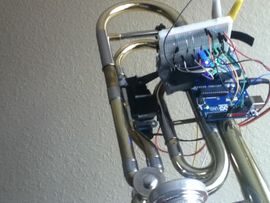
Here comes my completely unsolicited input, so snub up your man panties if you fall into that category…
I either love or detest the idea of using the main slide adjustment for everything. Here is what I mean…
My Alexander 163 came to me with an MTS tuning stick. I tried like the dickens to get used to it. After a while, I discovered that just about every pitch on the horn could be fixed using the 1st slide (which is how I had been trained since my "young whelp" days), so I quickly removed that dang, hated stick from the horn.
EVERYTHING ABOUT THE HORN GOT BETTER after I made this discovery.
Like Joe, I really hate having to move "home base", as that is my fixed reference point for how much to push or pull. I want the slide "there" as I press the valve, not after, so I need to know where it will go. If I am on a note that needs a long pull, move to one that is a medium push, then play an in-tune note, extra CPU processing time is needed for me to "correct the correction". Big, dumb guys such as myself can easily get lost in all of this adjustment. I personally need a pitch "home base" from which to work.
FOR ME, then, the best system of all is the Marzan-style top correction slide WITH A SEPARATE MAIN SLIDE FOR OVERALL TUNING. I want TWO main slides. My Kalison Daryl Smith prototype (bought from Paul K in Philly in 1993) had two MT slides, and I rigged the top one to be adjustable with my left hand. It was wonderful, unlike the terrible time I had with the Alex until I wised up and stopped trying to use the ONLY main slide for tuning.
Regarding the 4+2 system: I have only experienced 6-valved tubas that were so out of tune that you NEEDED the additional choices the 6th valve gave the player. The low ranges were so bad that the 5th and 6th were sort of like acoustic appendices, with little to no use.
Until Joe gave me a true eureka moment by explaining to me how he used the 6th valve on his Symphonie. You see, the few (doggy) 6-valved tubas I had played used the older system whereby the index finger was the long half step, and the middle finger was a long whole step, and this made NO SENSE to me. Then, when he explained that his was the opposite, and that they functioned as a 1 and 2 for a CC tuba (fingering-wise) when the 4th was down, it all just clicked: If you have a well-in-tune tuba with 6 valves (set up like Joe's), THIS IS BRILLIANT!
My Kurath, the ancestor to the later OG Willson 3200-FA-5, is a fine tuba, if perhaps a bit too big for its intended use (IMHO). The Willson has excellent intonation, with a few known bugs, which are unfortunately common in the F tuba world, and the Kurath is very similar to these horns in this regard.
I did a lot of work to my prototype Kurath, including correcting some truly bizarre stuff in the taper of the valve section that had to be Friday Afternoon Syndrome. Get it built. Get it packed. Get it shipped. Get paid. I won't go into the horrors I discovered, but it plays much better now. The intonation is better overall from any Willson 3200 and most of these earlier, very nicely made Kuraths. Adding a 6th valve totally changed how the horn plays below low C, and I love it.
I sold my excellent Adams F because I could not figure out where to shoehorn in a 6th valve, and did not want to go back to the restrictive nature of a 5-valved F. It was THAT much of an improvement (for me).
The ONLY thing I would like to do would be to add a proper 7th valve because that would make this a true double tuba, and the low range would become more or less perfect for me. The ONLY note in that range of this tuba is low Ab, and having a 7th would fix it nicely.
Alas, there is no room for another valve…
Unless…
Naaaaah…
I would like to try out a tuba modified as Joe suggests. However, I do not think I would
gain much from it that I cannot
already achieve with the easily accessible 3rd slides on both tubas, despite the small hand movements required for these adjustments. Still, it would be great to have the 23 series under easier control without having to move my hard.
For me, though, the double MTS setup I had on my Kalison was wonderful. I tuned the horn with the lower slide, and then adjusted it with the upper. I could fix the open pitches too, that way, while never losing my baseline pitch adjustment. If the group blew sharp on some big, Mahler-esque passage, I could keep up by pushing in the adjuster slide until I could get a hand down to the main slide.
The Tune-Any-Note feature on Kanstul G bugles worked like this. There was a front "tuning" slide on the bugle, then a rear "adjustment" slide with a thumb saddle or ring. This was an outgrowth of the infamous "cheater" slides used by the Bue Devils on their King bugles around 1983, which had a tubing layout that would allow for a saddle on the main slide that could be adjusted by the left thumb (replacing the adjuster on the 1st slide). These were
very illegal, and they had to remove them.
Zig saw the need for such a contraption, and when he started building his own-brand bugles, he worked that into the design. This was modified and then included on all of his later Bb/F marching brass and eventually all of his tubas (I think). It is a great idea, but it ends up needing too much cylindrical tubing to use on a really large tuba, IMHO, without introducing weirdness. It worked well on his F tubas, though.
[Perhaps the two-slide system was only on the prototypes I played? I never played a production Kanstul instrument, so I honestly do not know what the production version of Tune-Any-Note was like. I suspect it moved to a single slide, and I would have hated that. But it would have been simpler, faster, and cheaper for them to make.]
And those are my random, detached thoughts about everything I read above this reply to Joe's thread.
And they lived happily ever after.
The End