Page 3 of 4
Re: "Mass/weight changes how a brass instrument mouthpiece plays an instrument."
Posted: Sat Mar 14, 2026 7:57 am
by Rick Denney
Just for fun:
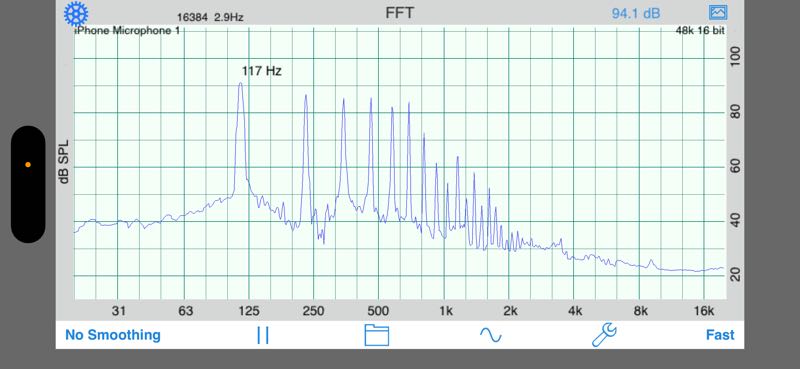
Here’s the frequency spectrum of me playing a Bb2 on the Miraphone 186 using my preferred OG Ultimate:

- IMG_1934-dsqz.jpeg (40.23 KiB) Viewed 6126 times
Same note with a Mike Finn 4, which is a (good) heavyweight shallow F-tuba mouthpiece.
- IMG_1935-dsqz.jpeg (40.64 KiB) Viewed 6126 times
The shallower mouthpiece adds more harmonic content, and it sounds different. But I see no evidence whatsoever of the mouthpiece ringing at 5.9 KHz, versus the more attenuated and lower ringing frequency of the OG Ultimate.
Rick “not carefully collected data, but at least I played the Bb in tune” Denney
Re: "Mass/weight changes how a brass instrument mouthpiece plays an instrument."
Posted: Sat Mar 14, 2026 8:55 am
by bloke
In the same way that sometimes we want to turn the treble up or down on a guitar amplifier or a bass guitar amplifier, we do the same thing with different tubas and different mouthpieces.
Interestingly with an amplifier, I find myself usually leaving the bass knob about in the same spot, and only monkeying with the treble knob.
Re: "Mass/weight changes how a brass instrument mouthpiece plays an instrument."
Posted: Sat Mar 14, 2026 5:35 pm
by Yahnay-san
Good work Rick! I did similar spectrum analyses of tuba sound 25 odd years ago as a way to have fun learning sound analysis software for work, and found similar results: shallower mouthpieces producing more upper harmonics, correlating with “brighter” sound. Try a trombone and watch the peaks march up the frequency axis while hardly diminishing (square waves)! Not working there any more, but I should be able to rig up something with bits of hardware I have at home and some open source software, though the last time I tried something like this I discovered WHY they get away with charging big $ for the commercial software. I might even have regular and heavy versions of the same mouthpiece to answer the question posed in the thread. Yeah, that’s why I bought all those mouthpieces: science!
Re: "Mass/weight changes how a brass instrument mouthpiece plays an instrument."
Posted: Sat Mar 14, 2026 6:49 pm
by gocsick
Rick Denney wrote: Sat Mar 14, 2026 7:40 am
bloke wrote: Sat Mar 14, 2026 7:14 am
@Rick Denney
As far as old school machining is concerned, there's a little set of steel contours that machinists used to purchase and keep for reference.
It's interesting how the different contours of tuba mouthpiece rims line up with that little set of contours.
I can't remember what they're called. I need to go down the street to my machinist friend and ask him to pull them out and tell me what they're called.
They’re called radius gauges. I have an old Lufkin set.
Rick “old Lufkin precision stuff was as good as Starrett back in the day” Denney
This just blew my mind.. Now I am going to have to pull out the the gauge set and compare against mouthpieces.
Re: "Mass/weight changes how a brass instrument mouthpiece plays an instrument."
Posted: Sun Mar 15, 2026 4:34 pm
by 1 Ton Tommy
Long, long ago I was hired as an apprentice tool maker at Boeing. We hand filed tools that made the aluminum ribs for the fuselage. The contours were important and we checked ourselves with one of several radius gauges. When the inspector came around he checked our work with his set of Lufkin gauges. The ones we checked out of the tool room were Starett.
All this precision as applied to mouthpieces is nowhere near as important as how many measures it's been since I last played, the temperature of the room and if My lip is tired from playing rock and roll at a gig the day before. Fortunately spring is on the way, the performance hall has a new heating system, and I may remember to put my mouthpiece in my pocket while the chorus sings. Playing outdoors in the wind the day before I can't do much about; I didn't book the gig.
Re: "Mass/weight changes how a brass instrument mouthpiece plays an instrument."
Posted: Sun Mar 15, 2026 4:43 pm
by Nemo
1 Ton Tommy wrote: Sun Mar 15, 2026 4:34 pm
Playing outdoors in the wind the day before I can't do much about; I didn't book the gig.
Crack open a vitamin E capsule and spread the goo on your lips when you go to bed after getting wind-burned, sunburned, or generally overplaying - works wonders for recovery
Re: vitamin E, frequency response, and cute curves
Posted: Sun Mar 15, 2026 5:50 pm
by bloke
.
Re: "Mass/weight changes how a brass instrument mouthpiece plays an instrument."
Posted: Sun Mar 15, 2026 8:13 pm
by Pauvog1
tubanh84 wrote: Wed Mar 11, 2026 5:11 pm
dsfinley wrote: Wed Mar 11, 2026 4:50 pm
I agree with this. I think the PT-50 and PT-50+ are equally as hard to play on.

I don't know if it was my two specific mouthpieces or what. I'd never had much of a preference for megatone or + or whatever people were calling them mouthpieces, EXCEPT my 50 and 50+.
Background - this was all on my PT6 (rotary)
The 50 was wild. If I needed bright, raw, noisy, loud, you name it, I went with the 50. That thing had no limit.
The 50+ was a LOT more refined. I could control it much easier. It didn't have the same top end as the 50, but it was a much more flexible mouthpiece.
I made the 50+ my everyday mouthpiece and really only plugged the 50 in to amuse myself and remind me why I liked the 50+.
I also couldn't play EITHER mouthpiece unless I was really in shape. If I took a few weeks or months off, I'd play my Helleberg for the first week back and then switch to the PTs.
Then I found the Mike Finn H and really haven't looked back.
I'm pretty sure I remember reading that the heavy version of the RT pieces have slight changes from standard weight. I image that being similar to Bach having the megatones with a larger/different throat.
Re: vitamin E, frequency response, and cute curves
Posted: Sun Mar 15, 2026 9:15 pm
by gocsick
I've wondered that myself... Tucci's website says
Robert Tucci Heavy-Shell mouthpieces offer substantial stability in high-volume performance environments. The shell weights, throat and backbores are calibrated to assist the player in controlling tonal output. Greater strength in tone production results in more efficiency and therefore superior results with less effort.
https://www.robert-tucci.com/mouthpieces.html
I've always interpreted that to mean there are other changes besides just the shell weight between the regular and + models.
Re: "Mass/weight changes how a brass instrument mouthpiece plays an instrument."
Posted: Mon Mar 16, 2026 9:49 pm
by kingrob76
bloke wrote: Thu Mar 12, 2026 8:33 pm
Don't all of those series feature huge throats, which would mean that you were putting as much air in there as those huge throats require - thus the air column was vibrating more than normal and causing that loose whatever to vibrate.
That is a
DAMN good point. It never happened on any other horn (the rattle). I have other heavy shells now and anecdotally I DO feel like a horn vibrates differently, but I don't have anywhere near enough data to substantiate a conclusion.
Re: vitamin E, frequency response, and cute curves
Posted: Wed Mar 18, 2026 12:38 am
by peterbas
Hmmm, seems to me that you can play as soft with a small throat as a large one. The air needed depends on the efficiency of the mouthpiece and more mass normally means a higer efficiency since there are less vibration losses.
More likley is that the harmonics serie of the mouthpieces are different so that one that makes the rattle just hits the vibration frequency of the thing hanging loose.
Re: vitamin E, frequency response, and cute curves
Posted: Wed Mar 18, 2026 8:19 am
by bloke
My personal experience is that it's easier to play at all dynamic ranges with a throat that's not so large as to be difficult for a human to control without spending half their waking hours practicing at home to be able to be able to play well on a huge throated mouthpiece.
I'm fine at the 8.1 - 8.2 mm range for most tubas, and smaller for F cimbasso - which is really not much of a tuba, anymore.
One of my mouthpiece throats features a venturi in the back bore, whereby the throat itself looks to be one of those huge throats, but - down at the venturi - the choke point is still about 8.2 .
I'm okay with diverse cup shapes and depths, as long my rim contour and rim width is in place, and the throat diameter is not blown out. My preferred rim contour and width can also be interpolated to different size "donuts" with me still being happy (from around or a bit over 33 mm down to around or bit over 32 mm inside spacing), depending on the instrument.
I'm no acoustician and I'm no scientist, but my trial and error conclusions are based on ease of playing and sound.
Re: vitamin E, frequency response, and cute curves
Posted: Wed Mar 18, 2026 8:34 am
by anadmai
Reading through this post... is there ANYTHING about Vitamin E, or did someone's AI just spit out random nonsense?
Re: vitamin E, frequency response, and cute curves
Posted: Wed Mar 18, 2026 2:15 pm
by Jim Williams
Rick Denney Wrote:
"But there is no carrier frequency or heterodyne reception in a tuba. The lips produce frequencies in the range of maybe up to 20 KHz, most of which is attenuated out because the tuba only resonates harmonic frequencies with any."
if there is no carrier, then how do we define the stream of air exiting the mouth and flowing into the tuba? The tuba could act like my cobweb or fan dipole antenna.
My non-physicist, non-engineer, enough to pass the Extra Class FCC test mind could see the input as amplitude modulated with respect to volume.
Each circuit in the tuba acts like a resonant antenna at some frequencies or others. Like my antennas, the input goes to the best-matched elements of the antenna (tuba) so on a C tuba there would be matches for the B flat harmonic series in the first valve circuit, some of which are better than others.
Jim "I've permanently blotted everything about the other forum out of my memory, but I've heard other brass-playing people with advanced EE degrees make an analogy between brass instruments and transmitters/antennas, and when I finger E flat and try to play F#, it doesn't sound resonant." Williams
Re: vitamin E, frequency response, and cute curves
Posted: Wed Mar 18, 2026 2:41 pm
by Nemo
anadmai wrote: Wed Mar 18, 2026 8:34 am
Reading through this post... is there ANYTHING about Vitamin E, or did someone's AI just spit out random nonsense?
I mentioned vitamin E for someone's lip troubles, bloke replied to it with a modified title and inadvertently changed the thread title as well. It stayed that way after he deleted his post, too
Re: vitamin E, frequency response, and cute curves
Posted: Wed Mar 18, 2026 3:32 pm
by peterbas
Jim Williams wrote: Wed Mar 18, 2026 2:15 pm
Rick Denney Wrote:
"But there is no carrier frequency or heterodyne reception in a tuba. The lips produce frequencies in the range of maybe up to 20 KHz, most of which is attenuated out because the tuba only resonates harmonic frequencies with any."
if there is no carrier, then how do we define the stream of air exiting the mouth and flowing into the tuba? The tuba could act like my cobweb or fan dipole antenna.
My non-physicist, non-engineer, enough to pass the Extra Class FCC test mind could see the input as amplitude modulated with respect to volume.
Each circuit in the tuba acts like a resonant antenna at some frequencies or others. Like my antennas, the input goes to the best-matched elements of the antenna (tuba) so on a C tuba there would be matches for the B flat harmonic series in the first valve circuit, some of which are better than others.
Jim "I've permanently blotted everything about the other forum out of my memory, but I've heard other brass-playing people with advanced EE degrees make an analogy between brass instruments and transmitters/antennas, and when I finger E flat and try to play F#, it doesn't sound resonant." Williams
Mostly used nowadays was the standing wave theory with the Bernoulli effect opening and closing the lips.
Last research I saw seems to think that 2 Helmholz resonators, you and the mouthpiece, and an energy pulse through the horn seems to model better for the first 3 octaves.
Main comment on the Bernoulli effect they have is that there is none when your lips close.
Re: "Mass/weight changes how a brass instrument mouthpiece plays an instrument."
Posted: Fri Mar 20, 2026 12:28 am
by peterbas
Rick Denney wrote: Sat Mar 14, 2026 7:57 am
Just for fun:
Here’s the frequency spectrum of me playing a Bb2 on the Miraphone 186 using my preferred OG Ultimate:
IMG_1934-dsqz.jpeg
Same note with a Mike Finn 4, which is a (good) heavyweight shallow F-tuba mouthpiece.
IMG_1935-dsqz.jpeg
The shallower mouthpiece adds more harmonic content, and it sounds different. But I see no evidence whatsoever of the mouthpiece ringing at 5.9 KHz, versus the more attenuated and lower ringing frequency of the OG Ultimate.
Rick “not carefully collected data, but at least I played the Bb in tune” Denney
Another thing you could try is seeing how good the harmonics series is followed and try some different mouthpieces to see how much if any the differ.
Re: vitamin E, frequency response, and cute curves
Posted: Fri Mar 20, 2026 11:26 am
by Mary Ann
I have a brass ring on the shank of my horn mouthpiece, given to me by Tom Greer (was a mouthpiece maker.) He said it didn't do anything but would look cool. I agreed.
Re: vitamin E, frequency response, and cute curves
Posted: Wed Mar 25, 2026 12:47 am
by Snake Charmer
For a friend having problems to get the power into his horn a repair guy put some thick wire around the ornamental groove between cup and shank and it made a big difference. He's still playing it after years this way.
I would like to compare the influence of the rims on my Blokepieces. There is a different feel in directness between the standard and the profundo rims (same diameter and shape) both on my Solo and Imperial cups. But as the profundo gives a deeper cup it's not easy to discern if it is the mass of the rim or the cup size making the bigger difference
Re: vitamin E, frequency response, and cute curves
Posted: Wed Mar 25, 2026 5:26 am
by Rick Denney
1. Never underestimate the placebo effect, even long-term.
2. Even without the inherent and inescapable bias to which all humans are subject, correlation does not prove causation.
3. If the rim changes the interior dimension even slightly, it’s no longer possible to even show correlation.
Rick “subjective testing must be controlled, but even with proper controls only perceptions of differences can be demonstrated by it” Denney
