repairing Yamaha sousaphones

Projects, repair topics, and Frankentubas
User avatar
bloke
Mid South Music
Posts: 24358
Joined: Thu Aug 13, 2020 8:55 am
Location: western Tennessee - near Memphis
Has thanked: 5223 times
Been thanked: 5885 times

repairing Yamaha sousaphones

Post by bloke »

Not many schools around here have bought Yamaha sousaphones, but I picked up an account last year whereby that school decide to buy a whole bunch of them due to a one-year head band director making that decision.

Even though these sousaphones are bizarre (along with being held together with screws instead of solder), they're actually pretty good.
It's just that they have the same issue as all the other Yamaha marching brass:
When they come in for summer repairs, all of the valves have to be repaired - even though they're not actually broken. (Anyone who has ever worked on any Yamaha marching brass knows exactly what I'm talking about.)

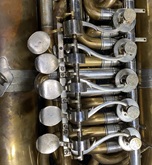
To make them easier to polish, the valve sections come off with those same tiny little screws that are found on the top action Yamaha tubas and the rotary Yamaha tubas. Additionally, the large body branches are screwed together at two junctures, which is even more bizarre.

One of them that I had to repair today had an obstruction way up around the shoulder area which was obviously some soft material like rubber or plastic, because dent balls (towards the obstruction) would not knock it out towards the large direction. Since the valve section came off, I reluctantly removed those six screws, wiggled It off, and ran one of those Roto-Rooter type of tools (that some of us own... yes, for actual plumbing) down through the fourth and third branches (nice sturdy braided cable on that tool) and knocked out the obstruction. It was one of those little water bottles all wadded up - and with the lid on it. One thing I know not to do is to undo all those crazy screws that hold the large branches together in two places. It just seems to me that if one of these instruments was smashed up so badly that I'd be tempted to unbolt those branches, once the dents were removed and the branches were slightly distorted, I'd never get all those screws back in. :eyes:

see...??
Typing up a bunch of crap about mundane school repairs is boring. Y'all just want to see us add seven additional valves to some York something or other... Oh yeah: and pictures. Y'all want to see pictures.
These users thanked the author bloke for the post:
catgrowlB (Fri Aug 01, 2025 3:53 pm)


MiBrassFS
Posts: 1625
Joined: Thu Mar 28, 2024 8:25 am
Has thanked: 0
Been thanked: 631 times

Re: repairing Yamaha sousaphones

Post by MiBrassFS »

.
Last edited by MiBrassFS on Fri Nov 07, 2025 4:40 pm, edited 2 times in total.
User avatar
bloke
Mid South Music
Posts: 24358
Joined: Thu Aug 13, 2020 8:55 am
Location: western Tennessee - near Memphis
Has thanked: 5223 times
Been thanked: 5885 times

Re: repairing Yamaha sousaphones

Post by bloke »

The Yamaha sousaphone bells that I just worked on here are soft, but not particularly thin. They had lots of dents and some creases, but they were pretty easy to fix. The fact that they only had one narrow reinforcement bead on the elbow (and the fact that they are seamed - rather than soldered - between the flare and the elbow - as with really really old King sousaphone bells.- meant that I could bump the dents out of their elbows through a single layer of metal instead of two).

The bodies are soft, but not as thin as King sousaphones have been for decades, and were also easy to straighten out.

No sousaphones are tough enough to be treated the way they are outdoors by 12 - 22 year old school children, and 100% of them are tough enough to service private owners who treat them as would mature adults.

The problem with the great big sousaphones - like the 20K and the Yamaha - is that their woofy sound doesn't offer enough articulation and punch for playing outdoors out in the middle of a football stadium, and thus the player is overworked attempting to compensate... I remember this from playing fiberglass 22K sousaphones over 45 years ago. I played an old circa 1960 30 lb. King in high school and then a 36K fiberglass. The 22K/20K - as far as size is concerned - is just a bridge too far, and I had to really blow the crap out of that thing to get the type of sound needed outdoors... Of course, that's where I learned to blow the crap out of a tuba in order to play that loudly. LOL (I know some people believe that brass sousaphones are louder than fiberglass. Those people are full of bull feathers.)

I know that taking detachable braces apart on beat up Yamaha large instruments can be a mistake, but sousaphones these are only about three years old and aren't beat up enough yet so as the braces wouldn't line back up.

I guess the summary is that the Yamaha sousaphones about as good as any, I'm personally not fond of 6/4 sousaphones, Yamahas are put together really goofy, their valves have all the same problems as with all the other Yamaha marching brass (quit working without actually being broken), but compared to how they're putting model 20K sousaphones together these days, I guess I'd pick Yamaha over the 20K, even though I wouldn't pick either were I able to not have to pick one of the two.

Had they never made the changes that they made with King sousaphones a few decades ago - and then the really stupid changes they've made more recently, yet reduced their weight down to maybe 26 lbs. (instead of even less, whereby they are really too thin now), I'd probably consider those to be just about perfect, but none of the sousaphones have ever been ideal. I guess the old 30 lb Kings were the closest to ideal. They were too heavy, but they tended to resist bad denting. ... Of all the makes of sousaphones that I have to repair - as far as valves are concerned, King almost never have valve issues (but actually neither do JP, even though their stainless steel pistons tolerances are closer than King).

valve guides:
All of the sousaphone and tuba manufacturers which make school instruments need to quit this bull crap with plastic valve guides on the top held in place by skinny little shave down valve stems and washers. It's just stupid. They all need to return to brass valve guides screwed into the sides of the pistons.


There. I typed a bunch of blather and finished this first morning cup of coffee. ' time to go slave over marching euphoniums!
MiBrassFS
Posts: 1625
Joined: Thu Mar 28, 2024 8:25 am
Has thanked: 0
Been thanked: 631 times

Re: repairing Yamaha sousaphones

Post by MiBrassFS »

.
Last edited by MiBrassFS on Fri Nov 07, 2025 4:40 pm, edited 1 time in total.
User avatar
bloke
Mid South Music
Posts: 24358
Joined: Thu Aug 13, 2020 8:55 am
Location: western Tennessee - near Memphis
Has thanked: 5223 times
Been thanked: 5885 times

Re: repairing Yamaha sousaphones

Post by bloke »

MiBrassFS wrote: Tue Jul 29, 2025 8:39 am Coffee good.

Image
MiBrassFS
Posts: 1625
Joined: Thu Mar 28, 2024 8:25 am
Has thanked: 0
Been thanked: 631 times

Re: repairing Yamaha sousaphones

Post by MiBrassFS »

.
Last edited by MiBrassFS on Fri Nov 07, 2025 4:40 pm, edited 1 time in total.
User avatar
bloke
Mid South Music
Posts: 24358
Joined: Thu Aug 13, 2020 8:55 am
Location: western Tennessee - near Memphis
Has thanked: 5223 times
Been thanked: 5885 times

Re: repairing Yamaha sousaphones

Post by bloke »

MiBrassFS wrote: Tue Jul 29, 2025 8:54 am I hate those things. More bag than bottle!
However, they do improve the sound of some sousaphone players.
gocsick
Posts: 1016
Joined: Mon Sep 11, 2023 11:12 am
Has thanked: 420 times
Been thanked: 493 times

Re: repairing Yamaha sousaphones

Post by gocsick »

bloke wrote: Tue Jul 29, 2025 7:04 am
valve guides:
All of the sousaphone and tuba manufacturers which make school instruments need to quit this bull crap with plastic valve guides on the top held in place by skinny little shave down valve stems and washers. It's just stupid. They all need to return to brass valve guides screwed into the sides of the pistons.
But then they couldn't have silent valves as they huff and puff down the field.


My biggest concern with new sousaphones is the poor quality plating on the valves. The valves on the 1960s 20K "practice" Sousaphones that have 50 seasons on then look new compared to the ones on the 10 year old "Performance" horns (that only her used for Friday night games, Saturday night competitions, and 2 parades a year...

The valves on the previous Jupiter Sousaphones were horrendous.

If there is one truth it is that high school sousa players never seen to have valve oil or understand the need to empty the water out of the horn before it goes back in the case..
Last edited by gocsick on Tue Jul 29, 2025 9:00 pm, edited 2 times in total.
As amateur as they come...I know just enough to be dangerous.

Meinl-Weston 20
Holton Medium Eb 3+1
Holton Collegiate Sousas in Eb and BBb
Conn 20J
and whole bunch of other "Stuff"
User avatar
arpthark
Posts: 5771
Joined: Mon Aug 24, 2020 4:25 pm
Has thanked: 1773 times
Been thanked: 1912 times

Re: repairing Yamaha sousaphones

Post by arpthark »

I marched Yamahas in college at Kentucky.

I felt like the tolerances in the valves were much too tight, even with oiling, which I did regularly. I had trouble getting the valves out of the casing. They stuck constantly. Other folks’ valves would randomly seize while playing. They also constantly rode about 20¢ sharp. I despised those things.

I had marched an old battle-worn 20K in high school, and much preferred that, although, sure, it was a rather diffuse sound.
User avatar
bloke
Mid South Music
Posts: 24358
Joined: Thu Aug 13, 2020 8:55 am
Location: western Tennessee - near Memphis
Has thanked: 5223 times
Been thanked: 5885 times

Re: repairing Yamaha sousaphones

Post by bloke »

@gocsick

I could "deal with" the older Jupiter sousaphone pistons:

- Tolerances were just a bit sloppy, but not so as they "leaked", YET rarely ended up with ACTUAL valve problems, because slightly damaged casings were large enough to still allow the pistons to pass through.

- Yes, they would collect brass oxide from the casings, but all I had to do with those was to take them into the buffing room, gently buff that crap off the surface, wash them off with detergent, and stick them back in the instruments.

Now that they are stainless steel, they no longer collect brass oxide from the casings, but they ALSO tightened up the tolerance YET (at least, it seems to me) without stepping up the precision in the machine work...so (with the newer valves) I encounter more ACTUAL problems (pistons which won't go up-and-down in their casings for reasons OTHER THAN (simply) a big build-up of brass oxide on the pistons' surfaces.

Hey...right now I smell like a goat, BUT I repaired one (really messed up $YXX) Yamaha marching mellophone today, one (really messed up $YXX) Yamaha marching baritone, and three other run-of-the-mill messed up ($XXX) Yamaha marching baritones...

...SO FAR...

I"m going BACK OUT NOW (9:30 P.M.) to see how far I can get through a pile of four Jimbo marching euphoniums' problems (in typically busted-zipper cases).

Once those are done, there are a couple of Bach bass trombones, a couple of Bach 42 trombones, three (or four??) random double horns and this university (as far as the brass is concerned) will be D-O-N-E done...and Mrs. bloke is just about as far along through their woodwinds, so we'll likely finish at the same time.

After that, there are only three middle schools to do (probably "in the nick of time") and we're selling a high and middle school (because there's left over $$$$ from their middle and high school repair budgets) each a "goofball" home-practice tuba. One is one of those old 3/4 size 4-valve Meinl-Weston model 11 tubas (no dents, and never refinished, but ugly brown), and the other is an old long-ago-re-lacquered gigantic Reynolds (22" bell) 3-valve recording bass.
I priced the pair out for just a little bit less than they're worth, but they finish eating up that school system's repair budget to the penny.

Hey...I sold one school system a "batch" of OG Ultimate mouthpieces (for use with their King BB-flat contras). I gave them a "school" price for buying a nice batch of them. It's still a bit more each that the PT mpc's, but a fair discount for a good quantity purchase.

I'd like to sell "batches" of them to a bunch of high schools !

re: "old 20K sousaphones (Elkhart)
I have 6 of them to restore and sell (probably to one of the local universities which has been buying the new $12,500 ones - and having a BUNCH of valve problems with them)...The valves on these ancient ones are neither leaky nor worn...and the bodies are NOT paper thin...and (without all that silly jazz that they're mounting on the new ones - extra braces, and a pillow block, no less) they probably weigh LESS than the new super-thin-walled ones.

silent valve action on the marching field:
a must.
MiBrassFS
Posts: 1625
Joined: Thu Mar 28, 2024 8:25 am
Has thanked: 0
Been thanked: 631 times

Re: repairing Yamaha sousaphones

Post by MiBrassFS »

.
Last edited by MiBrassFS on Fri Nov 07, 2025 4:41 pm, edited 1 time in total.
catgrowlB
Posts: 318
Joined: Tue Jun 13, 2023 8:46 pm
Has thanked: 296 times
Been thanked: 124 times

Re: repairing Yamaha sousaphones

Post by catgrowlB »

Ya know, I actually like those Yamaha 411 sousas. There is a small college close by that has 4 of them; I've played and serviced all of them. The biggest issue, imo, is the crazy tight tolerance piston valves that seize up during hot weather. Hot temperature/sun will dry those valves out fast, and you have to oil them to keep them from locking up. And the plastic guides get chewed up and need to be replaced at some point.
And yeah, they seemed to be pitched sharp. You have to use 2 bits and pull the MTS out quite a bit.

But overall, I like the way they play/sound and really like the build quality. Honestly, they are probably as close as you are going to get to HN White quality for a modern day sousa. I love that the bell is brazed/seamed, and the beefy bracing on those things.

I'd like to try the fiberglass Yamaha 301 sousa. Seems to use the same valveset/neck & bits, but fiberglass and smaller size, like an old Conn 36k or Selmer Signet. The 411 is 20k or King Giant sized...

Some years ago, I helped out at an exhibition with this small college band. Aside from some quirks here and there (maybe more in the upper brass), the sousa sound is clear and beefy.
I'm the odd/weird guy in the middle with my Selmer Signet :teeth: -- the others are on the school Yamaha 411s.
https://youtu.be/l2PSjlwNkCQ?feature=shared
I still help out when called for it (11 years or so now).

The director of that band recently retired, but loves lots of tuba. He is a big band/jazz and classical trumpet player, and still plays shows and gigs 💫
User avatar
bloke
Mid South Music
Posts: 24358
Joined: Thu Aug 13, 2020 8:55 am
Location: western Tennessee - near Memphis
Has thanked: 5223 times
Been thanked: 5885 times

Re: repairing Yamaha sousaphones

Post by bloke »

All the stuff you referring to is what I meant by 'repairing valves that aren't broken". The valve guides are garbage, but I guess one really can't complain too much when they cost less than a couple of bucks (unless someone is selling them on eBay :laugh: ).

Again, no tuba or baritone valves should rely on the valve stem to hold them in place. That's just crap.

Yes, the Yamaha sousaphone bracing is thick, but - when thick braces are cut in half and held together with tiny screws, that sort of compromises their strength.

playing characteristics:
They play okay...bland sounding, and good enough tuning.

I'm sure I could find a mouthpiece that would help get more definition out of their sound.

Yes you're correct:
If there's any lime build up at all on the casings, those valves are not going to move. Close tolerances, no oil, and lime build up... That's not a functional combination. I might be tempted to substitute PB Blaster for valve oil... except for the odor.

I'm not sure if you knew this, but the pistons are actually lead-soldered together (and then - of course - nickel plated). I guess that's okay...(??)... That having been said, it seems sort of temporary-ish to me.

two tuning bits and pull the main slide:
To me, that's what is called for with most any sousaphone, so I wouldn't particularly define that as sharp natured.

+ They seem to play okay. :thumbsup:
+ I wouldn't label them as sharp natured. :thumbsup:

Sousaphones have to straddle the wide fence between 95° and 35° F.
That's quite a challenge for manufacturers.

I (yeah I say the same stuff over and over again) like older King sousaphones that aren't worn out.
JP is the closest there is to those.
The JP valve sections are very sturdy, feature close tolerances, inexplicably, the Pistons don't seem to seize (maybe stainless steel makes a difference??) and the JP 1/4 inch diameter braces aren't cut in half and held together with little screws.
The JP pistons seem to fit in the casings about as well as European pistons fit in their casings.
JP sousaphones offer the punch that King sousaphones offer which I like. Although Mark Finley - in the past - raved about the JP intonation, I really think they don't quite play as well in tune as the good vintage King sousaphones, but better than Jupiter (which is not nearly as good of a King copy, nor as sturdy as JP, though - just one criticism - JP really needs to revisit their neck receiver bracing).
I can sell JP sousaphones with case and shipping for about half of what a school bid price is on a Yamaha. Were I not allowed to sell either - and had to keep it once given to me, I would choose JP over Yamaha for something which (hypothetically) I would be given as a gift to use forever.

Some may think that discussing sousaphone issues is like comparing brands of ketchup (ie. who cares?), but you guys discuss your $2500 to $6,000 Chinese C tubas, and I'm talking about a $9,000 to $11,000 sousaphone.
These users thanked the author bloke for the post:
gocsick (Fri Aug 01, 2025 9:17 pm)
gocsick
Posts: 1016
Joined: Mon Sep 11, 2023 11:12 am
Has thanked: 420 times
Been thanked: 493 times

Re: repairing Yamaha sousaphones

Post by gocsick »

bloke wrote: Fri Aug 01, 2025 4:56 pm

playing characteristics:
They play okay...bland sounding, and good enough tuning.

I'm sure I could find a mouthpiece that would help get more definition out of their sound.
That's how I feel about all Yamaha marching instruments and just if their concert horns too. In the what for uniformity they've someone eliminated the soul.

The sister school to my son's high school .. has RT-50+ for all their sousas . The director apparently wants everyone to sound the same... Talk about muddy... They have an excellent brass coach too.. if only the directors would listen to the expert they hired.
These users thanked the author gocsick for the post:
bloke (Fri Aug 01, 2025 10:19 pm)
As amateur as they come...I know just enough to be dangerous.

Meinl-Weston 20
Holton Medium Eb 3+1
Holton Collegiate Sousas in Eb and BBb
Conn 20J
and whole bunch of other "Stuff"
User avatar
bloke
Mid South Music
Posts: 24358
Joined: Thu Aug 13, 2020 8:55 am
Location: western Tennessee - near Memphis
Has thanked: 5223 times
Been thanked: 5885 times

Re: repairing Yamaha sousaphones

Post by bloke »

.... and fancy prices. They continue to be stamped "Japan"... Maybe...(??)

Playing "the ketchup of brass instruments" (marching brass) quite a bit each summer, King are about the best of them (though they seem to be more and more hastily assembled, as time passes), but I recently played a Kanstul F mellophone which played remarkably well. They don't count anymore, because they're no longer made and most of them that are still around are all beat up. 😐 Kanstul marching baritones (whether or not they play well in anyone's opinion) were made of sheet brass which is just too thin.

Older King marching instruments are quite restorable, due to their durability.

I like some of the early Yamaha instruments, including the early version of the 321 euphonium (I have one of those that probably cost me nearly $100), and I liked the trumpets when they were patterned after Schilke, and when Yamaha ghost manufactured the Schilke M series trumpets.
I dislike nearly 100% of Yamaha's tubas, other than (though still quirky) the YFB-621 and the YCB-826. I would like the YEB-631, were it still made, and would like the YEB-632, were it that it featured the YEB-321 15-inch bell.

I also notice that Yamaha early single rotor bass trombones sound nearly like the Conn 72H instruments they copied, which is an admirable trait. I actually brought one of those back from the dead, which I still own. I'm pretty proud of that save job, as I just don't suspect there's any evidence of its former condition...

... I only got the bell section, which was a trade for a set of finger buttons for another instrument (if that gives you a hint at how bad the condition of the Yamaha bass trombone bell section was when I received it). I had one of those horrible undersized early 1960s F. E. Olds bass trombones - which played flat pushed all the way in and sounded terrible. The playing slides on those were titanic and - interestingly - duo bore: .554" - .564", as well as being tunable. I took the tunable duo bore Olds slide apart, trued it, and grafted it onto the Yamaha bell. It's remarkably good instrument. Yes, the slide is heavy, but very smooth. I just wish I was a little bit better trombone slide operator.

Next to it is a minty Olds pro-model valve trombone (with original minty hard case).
I consider the Olds to be the best of the latter 20th century American-made valve trombones.
(Additionally - sorta fun, ALL of the small-shank Olds trombone bell sections will bolt up to this valve section.)


Image

Image
MiBrassFS
Posts: 1625
Joined: Thu Mar 28, 2024 8:25 am
Has thanked: 0
Been thanked: 631 times

Re: repairing Yamaha sousaphones

Post by MiBrassFS »

.
Last edited by MiBrassFS on Fri Nov 07, 2025 4:41 pm, edited 1 time in total.
User avatar
bloke
Mid South Music
Posts: 24358
Joined: Thu Aug 13, 2020 8:55 am
Location: western Tennessee - near Memphis
Has thanked: 5223 times
Been thanked: 5885 times

Re: repairing Yamaha sousaphones

Post by bloke »

It seems to me as though the valves on much of the consumer piston low brass these days is designed to drop in and go up and down without being hand fit.

... Of course, they have to run a cigarette lighter over it.
User avatar
the elephant
Posts: 4777
Joined: Thu Aug 13, 2020 8:39 am
Location: 32°50'57.0"N 90°24'34.9"W
Has thanked: 2997 times
Been thanked: 2366 times

Re: repairing Yamaha sousaphones

Post by the elephant »

It is hard for me to believe that the company responsible for these sousaphones is the same one that produced my 826.

Two different planets. :smilie4:
Image
travisd
Posts: 162
Joined: Mon Mar 21, 2022 11:14 am
Has thanked: 26 times
Been thanked: 36 times

Re: repairing Yamaha sousaphones

Post by travisd »

the elephant wrote: Sat Aug 02, 2025 10:08 am It is hard for me to believe that the company responsible for these sousaphones is the same one that produced my 826.
To be fair, they also produce pianos, dirt bikes, boats/boat motors, golf carts, home stereos, and other industrial machinery.
User avatar
bloke
Mid South Music
Posts: 24358
Joined: Thu Aug 13, 2020 8:55 am
Location: western Tennessee - near Memphis
Has thanked: 5223 times
Been thanked: 5885 times

Re: repairing Yamaha sousaphones

Post by bloke »

the elephant wrote: Sat Aug 02, 2025 10:08 am It is hard for me to believe that the company responsible for these sousaphones is the same one that produced my 826.

Two different planets. :smilie4:
The 826 is the Corvette ZR1 of the line, which is only produced in order to promote the run-of-the-mill sedans and SUVs.

Most of Yamaha's other tubas are Malibu-ish crap.

The Yamaha line ain't comparable to Toyota...no way.
Post Reply